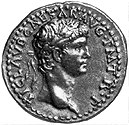
Tiberius Claudius Nero Germanicus (Claudius)
1 August 10 BC - 13 October 54 AD
Emperor AD 41-54
Tiberius Claudius Nero Germanicus (b. 10 BC, d. 54 A.D.; emperor, 41-54 A.D.) was the third emperor of the Julio-Claudian dynasty. His reign represents a turning point in the history of the Principate for a number of reasons, not the least for the manner of his accession and the implications it carried for the nature of the office. During his reign he promoted administrators who did not belong to the senatorial or equestrian classes, and was later vilified by authors who did. He followed Caesar in carrying Roman arms across the English Channel into Britain but, unlike his predecessor, he initiated the full-scale annexation of Britain as a province, which remains today the most closely studied corner of the Roman Empire. His relationships with his wives and children provide detailed insights into the perennial difficulties of the succession problem faced by all Roman Emperors. His final settlement in this regard was not lucky: he adopted his fourth wife's son, L. Domitius Ahenobarbus, who was to reign catastrophically as Nero and bring the dynasty to an end. Claudius's reign, therefore, was a mixture of successes and failures that leads into the last phase of the Julio-Claudian line.
Early Life (10 BC - 41 A.D. )
Claudius was born on 1 August 10 BC at Lugdunum in Gaul, into the heart of the Julio-Claudian dynasty: he was the son of Drusus Claudius Nero, the son of Augustus's wife Livia, and Antonia, the daughter of Mark Antony. His uncle, Tiberius, went on to become emperor in AD 14 and his brother Germanicus was marked out for succession to the purple when, in AD 4, he was adopted by Tiberius. It might be expected that Claudius, as a well-connected imperial prince, would have enjoyed the active public life customary for young men of his standing but this was not the case. In an age that despised weakness, Claudius was unfortunate enough to have been born with defects. He limped, he drooled, he stuttered and was constantly ill. His family members mistook these physical debilities as reflective of mental infirmity and generally kept him out of the public eye as an embarrassment. A sign of this familial disdain is that he remained under guardianship, like a woman, even after he had reached the age of majority. Suetonius, in particular, preserves comments of Antonia, his mother, and Livia, his grandmother, which are particularly cruel in their assessment of the boy. From the same source, however, it emerges that Augustus suspected that there was more to this "idiot" than met the eye. Nevertheless, Claudius spent his entire childhood and youth in almost complete seclusion. The normal rites de passage of an imperial prince came and went without official notice, and Claudius received no summons to public office or orders to command troops on the frontiers. When he assumed the toga virilis, for instance, he was carried to the Capitol in a litter at night; the normal procedure was to be led into the Forum by one's father or guardian in full public view. How he spent the voluminous free time of his youth is revealed by his later character: he read voraciously. He became a scholar of considerable ability and composed works on all subjects in the liberal arts, especially history; he was the last person we know of who could read Etruscan. These skills, and the knowledge of governmental institutions he acquired from studying history, were to stand him in good stead when he came to power.
It should not be forgotten that Claudius's wing of the family suffered terribly in the internal struggles for succession that racked the imperial house. His father died on campaign when Claudius was only one year old, and his beloved brother, Germanicus, succumbed under suspicious circumstances in AD 19. His only other sibling to reach adulthood, Livilla, became involved with Sejanus and paid the ultimate price in the wake of the latter's fall from grace in AD 31. Through all this turmoil Claudius survived, primarily through being ignored as an embarrassment and an idiot.
Claudius's fortunes changed somewhat when his unstable nephew, Gaius (Caligula), came to power in the spring of 37 A.D. Gaius, it seems, liked to use his bookish, frail uncle as the butt of cruel jokes and, in keeping with this pattern of behavior, promoted him to a suffect consulship on 1 July 37 A.D. At 46 years of age, it was Claudius's first public office. Despite this sortie into public life, he seemed destined for a relatively quiet and secluded dotage when, in January 41, events overtook him.
Accession
(24-25 January, 41 A.D.)
Arguably the most important period of Claudius's reign was its first few hours. The events surrounding his accession are worthy of detailed description, since they revealed much about the true nature of the Augustan Principate.
In the early afternoon of 24 January 41 A.D., the emperor Gaius was attending a display of dancers in a theater near the palace. Claudius was present. Shortly before lunch time, Claudius took his leave and the emperor decided that he, too, would adjourn for a bath. As Gaius was making his way down an isolated palace corridor he was surrounded and cut down by discontented members of his own bodyguard. In the aftermath of the assassination -- the first open murder of a Roman emperor -- there was widespread panic and confusion. The German elements of the emperor's bodyguard, who were fiercely loyal to their chief, went on the rampage and killed indiscriminately. Soldiers of the larger Praetorian Guard began looting the imperial palace. According to the best-known tradition, some Guardsmen found Claudius cowering behind a curtain and, on the spot, they declared him their emperor and carried him off to their camp. In this story, a hapless Claudius falls into power entirely as a result of accident, and very much against his will. It is not hard to see why, with its implicit theme of recusatio imperii, it is the story of his accession that Claudius himself favored. Vestiges, however, can be traced of another tradition that paints a somewhat different picture. In this version, the Guardsmen meet in their camp and discuss the situation facing them in light of Gaius's murder. Their pleasant, city-based terms of military service were in jeopardy. They needed an emperor. Fixing their intentions on Claudius as the only surviving mature member of the Julio-Claudian house, they sent out a party of troops to find him and bring him back to their camp so he could be acclaimed emperor, which is what happened. In this story, the elevation of Claudius to the purple was a purposeful plan on the part of the soldiers, even if Claudius remains a passive and reluctant partner in the whole process.
The possibility has to be entertained that Claudius was a far more active participant in his own elevation than either of these traditions let on. There is just reason to suspect that he may even have been involved in planning the murder of Gaius -- his departure from the theater minutes before the assassination appears altogether too fortuitous. These possibilities, however, must remain pure speculation, since the ancient evidence offers nothing explicit in the way of support for them. On the other hand, we can hardly expect them to, given the later pattern of events. The whole issue of Claudius's possible involvement in the death of Gaius and his own subsequent acclamation by the Praetorian Guard must, therefore, remain moot.
Despite the circumstances that brought him there, the hours following Claudius's arrival at the Praetorian Camp and his acceptance as emperor by the Senate are vital ones for the history of the Principate. Events could have taken a very different course, but that they worked out as they did speaks volumes as to how far seven decades of the Augustan Principate had removed Rome from the possibility of a return to the so-called free Republic.
News of Gaius's death prompted a meeting of the Senate. Initially, there was talk of declaring the Republic restored and dispensing with emperors altogether. Then, however, various senators began proposing that they be chosen as the next princeps. Debate was in progress when news reached the senators that the Guard had made the decision for them: Claudius, the soldiers' choice, was sitting in the Praetorian Camp. The main historical difficulty in what happened next is due to confusion in Josephus's account (which is the fullest). In one version, the Senate sent two tribunes to the Camp to demand that Claudius step down. Once in the Camp, however, the tribunes were cowed by the ardent support for Claudius among the soldiers and instead requested that he come to the Senate to be ratified as emperor. In Josephus's alternate version, however, Herod Agrippa is summoned by the senators and employed as an envoy between the Camp and the Senate. Clearly, Josephus is conveying two traditions about these events, one Roman (featuring the tribunes), the other Jewish (highlighting the role of Herod Agrippa). Suetonius, naturally enough, follows the Roman tradition, as does Dio in his main account; interestingly, the latter shows awareness of some participation on the part of Herod Agrippa in a later passage.
Regardless of how the negotiations were conducted, the Senate quickly realized it was powerless in the presence of several thousand armed men supporting Claudius's candidacy. The impotence that the esteemed council had experienced time and again when dealing with the military dynasts of the Late Republic was once more revealed to all, and the meeting dissolved with the fate of the Empire left undecided. When the Senate met again later that night in the Temple of Jupiter Victor, it found its numbers much depleted, since many had fled the city to their country estates. The senators assessed their military strength: they had three or four urban cohorts under the command of the City Prefect, numbering perhaps 3,000 men. With these, they occupied the Forum and Palatine. Plans were laid to arm some ex-slaves to provide reinforcements. By these actions the senators were accepting that supreme power in post-Augustan Rome could be achieved only by military force; all questions of legal niceties were irrelevant. But the Senate could not control their troops -- they all deserted to the Praetorian Guard, with whom they shared the Camp.
Now completely powerless, the senators hurried off to the Praetorian Camp to pay their respects to Claudius. On 25 January 41 A.D. Claudius was formally invested with all the powers of the princeps, becoming Ti. Claudius Caesar Augustus Germanicus. (Since Claudius had no legal claim to it whatsoever, the appearance of "Caesar" in his imperial name marks the first step in this word's transmutation from a family name to a title denoting ruler, and so begins a tradition that stretches into the modern era with "Kaiser," "Czar," and possibly "Shah.")
These events have been treated in some detail because of their immense historical importance. Gaius was the first emperor of Rome to be openly murdered, and Claudius's accession marks the first overt and large-scale intrusion of the military into post-Augustan politics. The basic fact of the Principate, which had always been implicit in the Augustan settlement but heretofore carefully disguised, was now made plain: the emperor's position ultimately rested not on consensus but on the swords of the soldiers who paid him homage. From one perspective, the Principate had been revealed for what it truly was -- an exercise in managing the military's loyalties, and not a form of government rooted in law and consensus. The Senate, in attempting to block Claudius with troops of their own, had acquiesced in this structure of power. For ever afterward, emperors sat on the throne on the sufferance of the troops they commanded, and a loss of army loyalty necessarily entailed a loss of power, usually accompanied by the loss of the incumbent's life. But the harder lessons in these realities lay in the future; for the moment order had been restored, and Claudius embarked on his reign in relative security.
The Early
Years: Britain, Freedmen, and Messalina (AD 41 - 48)
Among Claudius's first acts was the apprehension and execution of Gaius's assassins. Whatever his opinion of their actions, politics and pietas required that Claudius not be seen to condone men who murdered an emperor and a member of his own family. He also displayed immediate understanding of the centrality of the military to his position and sought to create a military image for himself that his prior sheltered existence had denied him. Preparations got under way soon after his accession for a major military expedition into Britain, perhaps sparked by an attempted revolt of the governor of Dalmatia, L. Arruntius Camillus Scribonianus, in 42 A.D.. The invasion itself, spearheaded by four legions, commenced in the summer of 43 and was to last for decades, ultimately falling short of the annexation of the whole island (if indeed that was Claudius's final objective at the outset). This move marked the first major addition to the territory of the Roman empire since the reign of Augustus. Claudius himself took part in the campaign, arriving in the war zone with an entourage of ex-consuls in the late summer of 43 A.D. After a parade at Camulodunum (Colchester) to impress the natives, he returned to Rome to celebrate a triumph in 44 A.D. His military credentials had been firmly established.
The sources are united in portraying Claudius as a dupe to his imperial freedmen advisors as well as to his wives. It is possible that the hostile stance of the elite toward Claudius extended back into his reign -- he was, after all, a usurper who had been foisted on the aristocrats by the soldiers. If so, Claudius's reliance on his freedmen may have stemmed from this circumstance, in that the ex-slaves were (as far as he was concerned) more trustworthy than the sullen aristocracy. For whatever reasons, there is no doubt that Claudius's reign is the first era of the great imperial freedman. To be sure, the secretariat had existed before Claudius and members of it had achieved some prominence (notably Helicon and Callistus under Gaius), but the rise of powerful individuals like Narcissus, Polybius, and Pallas was a distinctive mark of Claudius's reign. The power of these men was demonstrated early on when the emperor chose Narcissus as his envoy to the legions as they hesitated to embark on their invasion of Britain. According to our sources, the freedmen were frequently to exert less beneficent influences throughout Claudius's reign.
In 38 A.D. Claudius had married Valeria Messalina, a scion of a noble house with impressive familial connections. Messalina bore him a daughter (Octavia, born in 39) and a son (Britannicus, born in 41): she was therefore the mother of the heir-apparent and enjoyed influence for that reason. In the sources, Messalina is portrayed as little more than a pouting adolescent nymphomaniac who holds wild parties and arranges the deaths of former lovers or those who scorn her advances; and all this while her cuckolded husband blunders on in blissful ignorance. Recently, attempts have been made to rehabilitate Messalina as an astute player of court politics who used sex as a weapon, but in the end we have little way of knowing the truth. What we can say is that either her love of parties (on the adolescent model) or her byzantine scheming (on the able courtier model) brought her down. While Claudius was away in Ostia in AD 48, Messalina had a party in the palace in the course of which a marriage ceremony was performed (or playacted) between herself and a consul-designate, C. Silius. Whatever the intentions behind it, the political ramifications of this folly were sufficiently grave to cause the summary execution of Messalina, Silius, and assorted hangers-on (orchestrated, tellingly, by the freedman Narcissus). Claudius was now without a wife.
The Rise of Agrippina and Claudius's Death (48-54 A.D.)
In our sources, the death of Messalina is presented as initiating a scramble among the freedmen, each wishing to place his preferred candidate at Claudius's side as the new empress. In the end, it was Pallas who prevailed when he convinced Claudius to marry Agrippina the Younger. The marriage took place within months of Messalina's execution. Agrippina was a colorful figure with extensive and far-reaching imperial connections: she was the daughter of Claudius's brother, Germanicus, and a sister of Gaius Caligula, by whom she had been exiled for involvement in the conspiracy of Gaetulicus; moreover, she had been married before. She therefore brought to the marriage with Claudius -- which necessitated a change in the law to allow uncles to marry their brothers' daughters -- a son, L. Domitius Ahenobarbus. Agrippina's ambitions for this son proved the undoing of Claudius.
The years between his marriage to Agrippina in 48 and his death in 54 were difficult ones for Claudius. Whether or not sources are right to portray him as a dupe of his wives and freedmen throughout his reign, there can be little doubt that Agrippina's powerful personality dominated Claudius's last years. Her position, openly influential in a manner unlike any previous empress, was recognized by those attuned to imperial politics, and she appears more and more prominently in official inscriptions and coins. In 50 the Senate voted her the title "Augusta," the first prominent imperial woman to hold this title since Livia -- and the latter had only held it after Augustus's death. She greeted foreign embassies to the emperor at Rome from her own tribunal, and those greetings were recorded in official documents; she also wore a gold-embroidered military cloak at official functions. It is a sign of her overt influence that a new colony on the Rhine bore her name. Agrippina's powerful position facilitated the advancement of her son Domitius and was, in turn, strengthened by it. Claudius already had a natural son, Britannicus, who was still a minor. Domitius, at 13, was three years older. Now Claudius began to advance Domitius through various signs of favor, the most important being his adoption as Claudius's son on 25 February AD 50. Henceforth Domitius was known as Nero Claudius Drusus Germanicus Caesar and known to posterity simply as "Nero". But Claudius openly advanced Nero in other ways, too: the emperor held the consulship in 51, which was the year Nero took the "toga of manhood," and that event was itself staged several months before the customary age for Roman teenagers; Nero was granted imperium proconsulare outside the city, addressed the Senate, appeared with Claudius at circus games (while Britannicus appeared still in the toga of a minor), and was hailed as "Leader of the Youth" (princeps iuventutis) on the coinage; in AD 53 Nero married Claudius's daughter, Octavia. All of these are sure signs of preference in the ever-unstable imperial succession schemes. The main difficulty for modern scholars lies in how to explain Claudius's favoring of Nero over his natural son, Britannicus; the reasons remain a matter of intense debate.
No matter what the reasons were, there can be little doubt that Nero, despite his tender age, had been clearly marked out as Claudius's successor. Agrippina, according to Tacitus, now decided it was time to dispose of Claudius to allow Nero to take over. The ancient accounts are confused -- as is habitual in the cases of hidden and dubious deaths of emperors -- but their general drift is that Claudius was poisoned with a treated mushroom, that he lingered a while and had to be poisoned a second time before dying on 13 October 54 A.D. At noon that same day, the sixteen-year-old Nero was acclaimed emperor in a carefully orchestrated piece of political theater. Already familiar to the army and the public, he faced no serious challenges to his authority.
Claudius may have had a premonition of his end since he appointed no magistrates beyond the month of his death. According to Suetonius and Dio, Claudius hugged Britannicus saying he wished to make amends and looked forward to the day when his son would reach manhood, and was prepared to make him his successor "so the Roman people would at last have a genuine Caesar." Tacitus gives a version of this story but with Narcissus vowing to right the wrongs committed against Britannicus, suicidally declaring to punish the murderers of his mother. The story, however, is meant to provide justification for Agrippina to seek Claudius’ murder. Tacitus gives Narcissus the active role to indicate that Claudius was feeble and unable to work his will. But the fact that Narcissus was allowed to remain unmolested at court is an indication that Claudius was fully in charge of affairs. This story is also strongly reminiscent of Augustus’ supposed reconciliation with Agrippa Postumous which persuaded Livia to murder him. The only development along these lines which is not suspect is one by Suetonius that Claudius made his will and sealed it.
If Britannicus’ claim to power was to be maintained he had to assume the toga virilis by the age of 14 (March 55). The advancement of his son may have been a sharply disputed topic between Claudius and Agrippina. Suetonius notes that Claudius regretted his advancement of Nero. However, it is unlikely that Claudius was opposed to Nero’s place in the succession. He had declared Nero was capable of administering the State but wanted to stick to the original plan of both Nero and Britannicus succeeding him; Agrippina was equally determined to have Nero alone succeed Claudius.
The timeliness of Claudius’ death predisposes us to believe he was murdered. Narcissus was absent when Claudius died, gone to Sinuessa on the suggestion of Agrippina for his gout. This fosters suspicion but Narcissus could not have guaranteed Claudius’ life and his absence only helped to make Nero’s succession smoother. Claudius had always been weak and was 64 years old. He may have been ill during the autumn of 51 but certainly had a serious illness late in 52 or early 53.
Ancient historians are in general agreement that Agrippina murdered Claudius. Josephus expressed reservations by using phrases such as "it was reported by some" but this is a minority opinion. Claudius, like many rulers, took small amounts of poison to build up an immunity, a serious complication for Agrippina. Rather than using a slow-acting or a rapid poison that would give itself away she procured something powerful that would befuddle him and gradually cause death from Locusta, who was recently convicted on a charge of poisoning.
If Claudius was murdered it cannot be proven. The diverse accounts of his death make it impossible to be sure of the facts. What is known is that Claudius attended a priestly banquet on the capitol for the Augustalia of October 12. His taster, the eunuch Halotus, was present. The next day he had his last dinner at the palace. Tacitus says the task of administering the drug was given to Halotus traditionally in a dish of mushrooms to which Agrippina had added a concoction made by the imprisoned Locusta. The first attempt failed and Claudius’ doctor put a poisoned feather down his throat which proved to be the fatal blow. Suetonius is undecided on who did the murder naming both Halotus and Agrippina and mentioning both dinners.
Halotus suffered no stain on his reputation for his role in the murder and was rewarded with a procuratorship by Galba, who also had Locusta executed. Pliny wrote that Agrippina actually used a poisonous mushroom which makes real sense since Seneca reported that a careless selection of mushrooms accidentally poisoned his friend, Annaeus Serenus, the prefect of the watch along with some of his officers.
The effects of the poison are as various as the discussion of the plot itself. Suetonius says that Claudius lost the power to speak and had terrible pain as he died, just before dawn. He also suggests a second dose of poison was administered using a highly improbable syringe. Dio says the poison made it appear Claudius was merely drunk, not an uncommon habit for him. Suetonius also reports other authorities stating that Claudius passed out, vomited the contents of his stomach and seemed to recover before given more poison.
Tacitus reflects the traditional belief concerning Claudius’ death. He says that Claudius survived the first dose of poison perhaps from his sluggish condition or from his acquired immunity, and passed the poison by bowel movement. Then, the emperor was given a second dose by Agrippina aided by a doctor, Gaius Stertenius Xenophon, who had been highly regarded by Claudius but seemed happy to commit murder for profit using a poisoned feather pretending he was attempting to induce vomiting.
Accusation alone is not enough to prove Agrippina murdered Claudius but circumstantial evidence tends to place blame on her. The longer the succession was delayed the more likely Nero would have to share it with Britannicus. If Britannicus’ claim to power was to be maintained he had to assume the toga virilis by the age of 14 (March 55). The advancement of his son may have been a sharply disputed topic between Claudius and Agrippina. Suetonius notes that Claudius regretted his advancement of Nero. However, it is unlikely that Claudius was opposed to Nero’s place in the succession, he wanted to stick to the original plan. There may have been reasons to be concerned over Britannicus’ ability to hold power. Tacitus claims that Britannicus was an intelligent boy but also mentions that he suffered from epilepsy.
It is noteworthy that a unusually high number of magistrates died in the months before Claudius. The emperor liked to remain in Rome during the summer to hold court rather than travel to the countryside. According to the Apocolocyntosis it was an unhealthy summer and in the satire Claudius is carried off by Febris (Fever). This might reflect a tradition that Claudius died of malaria. Several natural causes of death have been put forward from a heart attack to gastro-enteritis.
Claudius’ death was kept a secret while the Senate convened and priests spoke prayers for his recovery. His body was smothered in blankets to hinder rigor mortis and prevent a time of death being from being discovered. Agrippina issued bulletins, just like Livia following Augustus’ death, and prevented Britannicus and his sisters from seeing their father. While this was going on Nero was being prepared to become Claudius’ sole successor. Britannicus may have been Claudius’ rightful heir but Nero had become his legal heir and had been clearly marked out for the succession. Burrus was probably busy ensuring a loyal cohort of guards would be on duty for the announcement and Seneca prepared a speech for the young Nero to deliver before the guards and the senate. That time was needed to prepare Nero’s accession suggests that Claudius’’ murder was not pre-meditated leaving the conspirators scrambling. Another reason may have been to make the death fit an auspicious time predicted by astrologers. This may be behind a remark may in the Apocolocyntosis where October 13 is declared "the first of a highly auspicious age." It was finally announced that Claudius died shortly after midday and, if the Apocolocyntosis can be taken as reflecting the official account, he died happily watching comic actors.
The Senate met late that day anticipating the reading of Claudius’ will, but it was never read. Dio claims that Nero destroyed the will because it favored Britannicus. Suetonius also claims Claudius had changed the document following his reconciliation with his son. It is doubtful that Claudius would have named his son as his sole successor leaving him to face an impossible task of consolidating his power. Traditionalist that Claudius was he probably divided his estate between Nero and Britannicus and commended both of them to the care of the Senate as join heirs.
Following the ceremony established for Augustus’ funeral, Agrippina would have had Claudius’ body lie in state for six days before it was cremated and placed in the mausoleum of Augustus (October 18.) Nero delivered the funeral eulogy written by Seneca. On October 19, Nero entered the Senate and formally requested that Claudius be deified. This was essential for Agrippina as it would sanction the regime and she could look forward on her death to being raised among the gods; also, Nero could style himself Divi Filius. A grand and massive temple was begun on the Caelian Hill dwarfing all other sacred precincts in Rome. But it was not finished by the time of Agrippina’s murder in 59, and construction was abandoned. The temple was completed in the reign of Vespasian who wished to advertise his connection to Claudius to help legitimize his own regime.
Claudius
and the Empire
The invasion and annexation of Britain was by far the most important and significant event in Claudius's reign. But several other issues deserve attention: his relationship with and treatment of the aristocracy, his management of the provinces and their inhabitants, and his judicial practices, and his building activities. Before looking at these subjects, however, we should note that the long-lived notion that Claudius initiated a coherent policy of centralization in the Roman Empire -- evidenced in the centralization of provincial administration and judicial actions, in the creation of a departmental bureaucracy, his interference in financial affairs, and so on -- has been decisively disproven by a recent biography of Claudius. Whatever actions Claudius took in regard to the various wings of government, he did so without any unifying policy of centralization in mind.
Claudius's relationship with the Senate did not get off to a good start -- given the nature of his succession and the early revolt of Scribonianus with its ensuing show trials -- and it seems likely that distrust of the aristocracy is what impelled Claudius to elevate the role of his freedmen. During his reign, however, Claudius made efforts to conciliate Rome's leading council, but he also embarked on practices that redounded to his detriment, especially those of sponsoring the entrance men considered unworthy into the Order and hearing delicate cases behind closed doors (in camera). In the last analysis, the figures speak for themselves: 35 senators and several hundred Knights were driven to suicide or executed during the reign. The posthumous vilification of Claudius in the aristocratic tradition also bespeaks a deep bitterness and indicates that, ultimately, Claudius's relationship with the Senate showed little improvement over time. His reviving and holding the censorship in 47-48 is typical of the way the relationship between Senate and emperor misfired: Claudius, no doubt, thought he was adhering to ancient tradition, but the emperor-censor only succeeded in eliciting odium from those he was assessing.
Claudius was remembered (negatively) by tradition as being noticeably profligate in dispensing grants of Roman citizenship to provincials; he also admitted "long-haired" Gauls into the senatorial order, to the displeasure of the snobbish incumbents. Both of these practices demonstrate his concern for fair play and good government for the provinces, despite his largely sedentary reign: under Claudius are attributed the first issues of standing orders (mandata) from emperor to governor. In the organization of the provinces, Claudius appears to have preferred direct administration over client kingship. Under him the kingdoms of Mauretania, Lycia, Noricum, and Thrace were converted into provinces. Stable kingdoms, such as Bosporus and Cilicia, were left untouched. A good example of the pattern is Herod Agrippa I. This client prince had grown up at Rome and had been awarded tetrarchic lands in Galilee by Gaius (Caligula). As we saw above, he had been involved in the accession of Claudius and, as a reward for services rendered, he was granted Judaea and Samaria in addition to his former holdings. He fell from grace, however, when he suspiciously extended Jerusalem's walls and invited other eastern kings to a conference at Tiberias. He died suddenly in 44 A.D., after which his former kingdom again came under direct Roman rule.
One feature of Claudius's reign that the sources particularly criticize is his handling of judicial matters. While he was certainly diligent in attending to hearings and court proceedings -- he was constantly present in court and heard cases even during family celebrations and festal days -- the sources accuse him of interfering unduly with cases, of not listening to both sides of a case, of making ridiculous and/or savage rulings, and of hearing delicate cases in closed-door private sessions with only his advisors present. The most celebrated and infamous of the latter cases is that of Valerius Asiaticus, the Gallic ex-consul and one-time friend of Claudius, who fell from grace in 47, reputedly at Messalina's instigation. His case was heard in the emperor's bedroom and Asiaticus was forced to suicide. Even if a survey of surviving rulings by Claudius do not show him making silly decisions, his judicial practices caught such attention that Seneca's Apocolocyntosis ends with a courtroom scene with Claudius as the accused: he is not allowed to make his defence, is convicted, and condemned to be a powerless courtroom clerk. Such an image must have been most pleasing to the senatorial imagination.
Finally, there is Claudius's building activities. Public building was de rigueur for Roman emperors, and ancient accounts of individual reigns routinely include mention of imperial munificence. Matters hydraulic account for Claudius's greatest constructional achievements, in the form of a new aqueduct for the city of Rome, a new port at Portus near Ostia, and the draining of the Fucine Lake. The sources are at pains to highlight the almost catastrophic outcome of the latter project, but its scale cannot be denied. Suetonius's assessment that "his public works were grandiose and necessary rather than numerous" is entirely correct.
Conclusion
Robert
Graves' fictional characterization of Claudius as an essentially benign man
with a keen intelligence has tended to dominate the wider public's view of this
emperor. Close study of the sources, however, reveals a somewhat different kind
of man. In addition to his scholarly and cautious nature, he had a cruel streak,
as suggested by his addiction to gladiatorial games and his fondness for watching
his defeated opponents executed. He conducted closed-door (in camera ) trials
of leading citizens that frequently resulted in their ruin or deaths -- an unprecedented
and tyrannical pattern of behavior. He had his wife Messalina executed, and
he personally presided over a kangaroo court in the Praetorian Camp in which
many of her hangers-on lost their lives. He abandoned his own son Britannicus
to his fate and favored the advancement of Nero as his successor. While he cannot
be blamed for the disastrous way Nero's rule turned out, he must take some responsibility
for putting that most unsuitable youth on the throne. At the same time, his
reign was marked by some notable successes: the invasion of Britain, stability
and good government in the provinces, and successful management of client kingdoms.
Claudius, then, is a more enigmatic figure than the other Julio-Claudian emperors:
at once careful, intelligent, aware and respectful of tradition, but given to
bouts of rage and cruelty, willing to sacrifice precedent to expediency, and
utterly ruthless in his treatment of those who crossed him. Augustus's suspicion
that there was more to the timid Claudius than met the eye was more than fully
borne out by the events of his unexpected reign.
Arkenberg's Biography on Claudius:
Translated by J. C. Rolfe.
[Arkenberg Introduction]. Rolfe's annotations appear in brackets with no attribution; mine are noted. I have also replaced modern place names, as used by Rolfe, with those in use by the Romans and Hellenes; thus, for example, Rolfe's "Italy" is now "Italia".
I. THE father of Claudius Caesar, Drusus, who at first had the forename Decimus and later that of Nero, was born of Livia within three months after her marriage to Augustus [38 B.C.] (for she was with child at the time) and there was a suspicion that he was begotten by his stepfather in adulterous intercourse. Certain it is that this verse at once became current: "In three months time come children to the great." This Drusus, while holding the offices of quaestor and praetor, was in charge of the war in Rhaetia and later of that in Germania. He was the first of Roman generals to sail the northern Ocean [15 B.C.], and beyond the Rhine with prodigious labor he constructed [12-11 B.C.] the huge canals which to this very day are called by his name. Even after he had defeated the enemy in many battles and driven them far into the wilds of the interior, he did not cease his pursuit until the apparition of a barbarian woman of greater than human size, speaking in the Latin tongue, forbade him to push his victory further. For these exploits he received the honor of an ovation with the triumphal regalia; and immediately after his praetorship he became consul and resumed his campaign, but died in his summer camp [9 B.C.], which for that reason was given the name of "Accursed." The body was carried by the leading men of the free towns and colonies to Rome [cf.. Tib. vii.3], where it was met and received by the decuries of scribes [probably the scribae quaestorii, the quaestor's clerks, who were the most important of the attendants upon the magistrates. They formed a guild composed of six decuriae, or divisions of ten, presided over by six officers called sex primi curatorum], and buried in the Campus Martius. But the army reared a monument in his honor, about which the soldiers should make a ceremonial run [A decursus or decursio. After running around it in full armor, the soldiers cast into the fire the military prizes which they had received from the emperor.] each year thereafter on a stated day, which the cities of Gaul were to observe with prayers and sacrifices. The Senate, in addition to many other honors, voted him a marble arch adorned with trophies on the Appian Way, and the surname Germanicus for himself and his descendants. It is the general belief that he was as eager for glory as he was democratic by nature; for in addition to victories over the enemy he greatly desired to win the spolia opima [the armor of the leader of the enemy, taken from him in hand-to-hand combat by a Roman general], often pursuing the leaders of the Germans all over the field at great personal risk; and he made no secret of his intention of restoring the old-time form of government, whenever he should have the power. It is because of this, I think, that some have made bold to write that he was an object of suspicion to Augustus; that the emperor recalled him from his province, and when he did not obey at once, took him off by poison. This I have mentioned, rather not to pass it by, than that I think it true or even probable; for as a matter of fact Augustus loved him so dearly while he lived that he always named him joint-heir along with his sons, as he once declared in the senate; and when he was dead, he eulogized him warmly before the people, praying the gods to make his Caesars like Drusus, and to grant him, when his time came, as glorious a death as they had given that hero. And not content with carving a laudatory inscription on his tomb in verses of his own composition, Augustus also wrote a memoir of his life in prose. Drusus had several children by the younger Antonia, but was survived by only three, Germanicus, Livina, and Claudius.
II. Claudius was born at Lugdunum on the Kalends of August in the consulship of Iullus Antonius and Fabius Africanus, the very day when an altar was first dedicated to Augustus in that town [August 1, 10 B.C.], and he received the name of Tiberius Claudius Drusus. Later, on the adoption of his elder brother into the Julian family, he took the surname Germanicus. He lost his father when he was still an infant, and throughout almost the whole course of his childhood and youth he suffered so severely from various obstinate disorders that the vigor of both his mind and his body was dulled, and even when he reached the proper age he was not thought capable of any public or private business. For a long time, even after he reached the age of independence [Arkenberg: i.e., the age of his majority], he was in a state of pupillage and under a guardian, of whom he himself makes complaint in a book of his, saying that he was a barbarian and a former chief of muleteers, put in charge of him for the express purpose of punishing him with all possible severity for any cause whatever. It was also because of his weak health that contrary to all precedent he wore a cloak when he presided at the gladiatorial games which he and his brother gave in honor of their father; and on the day when he assumed the gown of manhood he was taken in a litter to the Capitol about midnight without the usual escort [of relatives and friends].
III. Yet he gave no slight attention to liberal studies from his earliest youth, and even published frequent specimens of his attainments in each line. But even so he could not attain any public position or inspire more favorable hopes of his future. His mother Antonia often called him "a monster of a man, not finished but merely begun by Dame Nature"---; and if she accused anyone of dullness, she used to say that he was "a bigger fool than her son Claudius." His grandmother Augusta [Arkenberg: i.e., Livia] always treated him with the utmost contempt, very rarely speaking to him; and when she admonished him, she did so in short, harsh letters, or through messengers. When his sister Livina heard that he would one day be emperor, she openly and loudly prayed that the Roman people might be spared so cruel and undeserved a fortune.
IV. Finally, to make it clearer what opinions, favorable and otherwise, his great uncle Augustus had of him, I have appended extracts from his own letters: "I have talked with Tiberius [the future emperor], my dear Livia, as you requested, with regard to what is to be done with your grandson Tiberius [i.e., Claudius] at the games of Mars [celebrated by Augustus in 12 A.D. in honor of Mars Ultor]. Now we are both agreed that we must decide once for all what plan we are to adopt in his case. For if he be sound and so to say complete, what reason have we for doubting that he ought to be advanced through the same grades and steps through which his brother has been advanced? But if we realize that he is wanting and defective in soundness of body and mind, we must not furnish the means of ridiculing both him and us to a public which is wont to scoff at and deride such things. Surely we shall always be in a stew, if we deliberate about each separate occasion and do not make up our minds in advance whether we think he can hold public offices or not. However, as to the matters about which you ask my present advice, I do not object to his having charge of the banquet of the priests at the games of Mars, if he will allow himself to be advised by his kinsman the son of Silvanus, so as not to do anything to make himself conspicuous or ridiculous. That he should view the games in the Circus from the Imperial box does not meet with my approval; for he will be conspicuous if exposed to full view in the front of the auditorium. I am opposed to his going to the Alban Mount or being in Rome on the days of the Latin festival; for why should he not be made prefect of the city, if he is able to attend his brother to the Mount? You have my views, my dear Livia, to wit that I desire that something be decided once for all about the whole matter, to save us from constantly wavering between hope and fear. Moreover, you may, if you wish, give this part of my letter to our kinswoman Antonia also to read. Again in another letter: "I certainly shall invite the young Tiberius to dinner every day during your absence, to keep him from dining alone with his friends Sulpicius and Athenodorus. I do wish that he would choose more carefully and in a less scatter-brained fashion someone to imitate in his movements, bearing, and gait. The poor fellow is unlucky; for in important matters, where his mind does not wander, the nobility of his character is apparent enough." Also in a third letter: "Confound me, dear Livia, if I am not surprised that your grandson Tiberius [i.e., Claudius] could please me with his declaiming. How in the world anyone who is so unclear in his conversation can speak with clearness and propriety when he declaims, is more than I can see." There is no doubt at all what Augustus later decided, and that he left him invested with no office other than the augural priesthood, not even naming him as one of his heirs, save in the third degree and to a sixth part of his estate, among those who were all but strangers; while the legacy that he left him was not more than eight hundred thousand sesterces.
V. His paternal uncle Tiberius gave him the consular regalia, when he asked for office; but when he urgently requested the actual position, Tiberius merely replied by a note in these words: "I have sent you forty gold-pieces for the Saturnalia and the Sigillaria [December 21 and 22, an extension of the Saturnalia, when it was customary to make presents of little images of various kinds (sigilla)]." Then at last Claudius abandoned all hope of advancement and gave himself up to idleness, living in obscurity now in his house and gardens in the suburbs, and sometimes at a villa in Campania; moreover, from his intimacy with the lowest of men he incurred the reproach of drunkenness and gambling, in addition to his former reputation for dullness. Yet all this time, despite his conduct, he never lacked attention from individuals or respect from the public.
VI. The equestrian order twice chose him as their patrons to head a deputation on their behalf: once when they asked from the consuls the privilege of carrying the body of Augustus to Rome on their shoulders, and again when they offered them their congratulations on the downfall of Seianus. They even used to rise when he appeared at the public shows and put off their cloaks. The Senate, too, voted that he be made a special member of the priests of Augustus, who were usually chosen by lot; when he later lost his house by fire, that it should be rebuilt at the public expense, and that he should have the honor of giving his opinion among the consulars. This second decree was however repealed, since Tiberius urged Claudius' infirmity as a reason, and promised that he would make the loss good through his own generosity. Yet when Tiberius died, he named Claudius only among his heirs in the third degree, to a third part of his estate, although he gave him in addition a legacy of about two million sesterces, and expressly commended him besides to the armies and to the Senate and People of Rome with the rest of his kinsfolk.
VII. It was only under his nephew Gaius [Arkenberg: i.e., Caligula], who in the early part of his reign tried to gain popularity by every device, that he at last began his official career, holding the consulship as his colleague for two months; and it chanced that as he entered the Forum for the first time with the fasces, an eagle that was flying by lit upon his shoulder. He was also allotted a second consulship, to be held four years later, and several times he presided at the shows in place of Gaius, and was greeted by the people now with "Success to the emperor's uncle!" and now with "All hail to the brother of Germanicus!"
VIII. But all this did not save him from constant insults; for if he came to dinner a little after the appointed time, he took his place with difficulty and only after making the round of the dining-room.
Whenever he went to sleep after dinner, which was a habit of his, he was pelted with the stones of olives and dates, and sometimes he was awakened by the jesters with a whip or cane, in pretended sport. They used also to put slippers on his hands as he lay snoring, so that when he was suddenly aroused he might rub his face with them.
IX. But he was exposed also to actual dangers. First in his very consulship, when he was all but deposed, because he had been somewhat slow in contracting for and setting up the statues of Nero and Drusus, the emperor's brothers. Afterwards he was continually harassed by all kinds of accusations, brought against him by strangers or even by the members of his household. Finally, when the conspiracy of Lepidus and Gaetulicus was detected and he was sent to Germania as one of the envoys to congratulate the emperor, he was really in peril of his life, since Gaius raged and fumed because his uncle of all men had been sent to him, as if to a child in need of a guardian. So great, indeed, was his wrath that some have written that Claudius was even thrown into the river clothes and all, just as he had come. Moreover, from that time on he always gave his opinion in the Senate last among the consulars, having the question put to him after all the rest by way of humiliation. A case involving the forgery of a will was even admitted in which Claudius himself was one of the signers. At last he was forced to pay eight million sesterces to enter a new priesthood, which reduced him to such straitened circumstances that he was unable to meet the obligation incurred to the treasury; whereupon by edict of the prefects his property was advertised for sale to meet the deficiency, in accordance with the law regulating confiscations.
X. Having spent the greater part of his life under these and like circumstances, he became emperor in his fiftieth year [41 A.D.] by a remarkable freak of fortune. When the assassins of Gaius shut out the crowd under pretense that the emperor wished to be alone, Claudius was ousted with the rest and withdrew to an apartment called the Hermaeum; and a little later, in great terror at the news of the murder, he stole away to a balcony hard by and hid among the curtains which hung before the door. As he cowered there, a common soldier, who was prowling about at random, saw his feet, and intending to ask who he was, pulled him out and recognized him; and when Claudius fell at his feet in terror, he hailed him as emperor. Then he took him to the rest of his comrades, who were as yet in a condition of uncertainty and purposeless rage. These placed him in a litter, took turns in carrying it, since his own bearers had made off, and bore him to the Camp in a state of despair and terror, while the throng that met him pitied him, as an innocent man who was being hurried off to execution. Received within the rampart, he spent the night among the sentries with much less hope than confidence; for the consuls with the Senate and the city cohorts had taken possession of the Forum and the Capitol, resolved on maintaining the public liberty. When he too was summoned to the House by the tribunes of the Plebeians, to give his advice on the situation, he sent word that "he was detained by force and compulsion." But the next day, since the Senate was dilatory in putting through its plans because of the tiresome bickering of those who held divergent views, while the populace, who stood about the hall, called for one ruler and expressly named Claudius, he allowed the armed assembly of the soldiers to swear allegiance to him, and promised each man fifteen thousand sesterces; being the first of the Caesars who resorted to bribery to secure the fidelity of the troops.
XI. As soon as his power was firmly established, he considered it of foremost importance to obliterate the memory of the two days when men had thought of changing the form of government.
Accordingly he made a decree that all that had been done and said during that period should be pardoned and forever forgotten; he kept his word too, save only that a few of the tribunes and centurions who had conspired against Gaius were put to death, both to make an example of them and because he knew that they had also demanded his own death. Then turning to the duties of family loyalty, he adopted as his most sacred and frequent oath "By Augustus." He had divine honors voted his grandmother Livia and a chariot drawn by elephants in the procession at the circuses like that of Augustus; also public offerings to the shades of his parents and in addition annual games in the Circus on his father's birthday, and for his mother a carriage to bear her image through the Circus and the surname of Augusta, which she had declined during her lifetime. In memory of his brothers, whom he took every opportunity of honoring, he brought out a Hellenic comedy in the contest at Naples, and awarded it the crown in accordance with the decision of the judges. He did not leave even Marcus Antonius unhonored or without grateful mention, declaring once in a proclamation that he requested the more earnestly that the birthday of his father Drusus be celebrated because it was the same as that of his grandfather Antonius. He completed the marble arch to Tiberius near Pompeius Magnus' theater, which had been voted some time before by the Senate, but left unfinished. Even in the case of Gaius, while he annulled all his acts, yet he would not allow the day of his death to be added to the festivals, although it was also the beginning of his own reign.
XII. But in adding to his own dignity he was modest and unassuming, refraining from taking the forename Imperator, refusing excessive honors, and passing over the betrothal of his daughter and the birthday of a grandson in silence and with merely private ceremonies. He recalled no one from exile except with the approval of the Senate. He obtained from the members as a favor the privilege of bringing into the House with him the prefect of the praetorian guard and the tribunes of the soldiers, and the ratification of the judicial acts of his agents in the provinces. He asked the consuls for permission to hold fairs on his private estates. He often appeared as one of the advisers at cases tried before the magistrates; and when they gave games, he also arose with the rest of the audience and showed his respect by acclamations and applause. When the tribunes of the Plebeians appeared before him as he sat upon the tribunal, he apologized to them because for lack of room he could not hear them unless they stood up. By such conduct he won so much love and devotion in a short time, that when it was reported that he had been waylaid and killed on a journey to Ostia, the people were horror stricken and with dreadful execrations continued to assail the soldiers as traitors, and the Senate as murderers, until finally one or two men, and later several, were brought forward upon the Rostra by the magistrates and assured the people that Claudius was safe and on his way to the city.
XIII. Yet he did not remain throughout without experience of treachery, but he was attacked by individuals, by a conspiracy, and finally by a civil war. A man of the Plebeians was caught near his bed-chamber in the middle of the night, dagger in hand; and two members of the equestrian order were found lying in wait for him in public places, one ready to attack him with a sword-cane as he came out of the theater, the other with a hunting knife as he was sacrificing in the temple of Mars.
Asinius Gallus and Statilius Corvinus, grandsons of the orators Pollio and Messala, conspired to overthrow him, aided by a number of his own freedmen and slaves. The civil war was set on foot by Furius Camillus Scribonianus, governor of Dalmatia; but his rebellion was put down within five days, since the legions which had changed their allegiance were turned from their purpose by superstitious fear; for when the order was given to march to their new commander, by some providential chance the eagles could not be adorned---nor the standards pulled up and moved.
XIV. He held four consulships in addition to his original one [42, 43, 47, & 51 A.D.]. Of these the first two were in successive years, while the other two followed at intervals of four years each, the last for six months, the others for two; and in his third he was substituted for one of the consuls who had died, a thing which was without precedent in the case of an emperor. He administered justice most conscientiously both as consul and when out of office, even on his own anniversaries and those of his family, and sometimes even on festivals of ancient date and days of ill-omen. He did not always follow the letter of the laws, but modified their severity or lenity in many cases according to his own notions of equity and justice; for he allowed a new trial to those who had lost their cases before private judges by demanding more than the law prescribed, while, overstepping the lawful penalty, he condemned to the wild beasts those who were convicted of especially heinous crimes.
XV. But in hearing and deciding cases [before his own tribunal] he showed strange inconsistency of temper, for he was now careful and shrewd, sometimes hasty and inconsiderate, occasionally silly and like a crazy man. In revising the lists of the divisions of jurors [more literally, "the decuries for court duty," to distinguish them from the decuries of equites, scribes, etc.] he disqualified a man who had presented himself without mentioning that he was immune because of the number of his children [That is, he enjoyed the privileges of the Ius Trium Liberorum, one of which was freedom from jury duty.] on the ground that he had a passion for jury duty. Another, who was challenged by his opponents about a suit of his own, said that it did not come before Caesar's tribunal, but the ordinary courts; whereupon Claudius compelled him at once to bring the case before him, saying that the man would show in a case affecting his own interests how just a juror he would be in the affairs of others. When a woman refused to recognize her son, and the evidence on both sides was conflicting, he forced her to admit the truth by ordering her to marry the young man. Whenever one party to a suit was absent, he was prone to decide in favor of the one who was present without considering whether his opponent had failed to appear through his own fault or from a necessary cause [Cf.., Dio, 60.28]. On a man's being convicted of forgery, some one cried out that his hands ought to be cut off; whereupon Claudius insisted that an executioner be summoned at once with knife and block. In a case involving citizenship a fruitless dispute arose among the advocates as to whether the defendant ought to make his appearance in the toga [Only a Roman citizen had the right to wear the toga] or in a Hellenic mantle, and the emperor, with the idea of showing absolute impartiality, made him change his garb several times, according as he was accused or defended. In one case he is credited with having rendered the following decision, which he had actually written out beforehand: "I decide in favor of those who have told the truth." By such acts as these he so discredited himself that he was held in general and open contempt. One man in making excuses for a witness that the emperor had summoned from one of the provinces, said that he could not appear, but for a long time would give no reason; at last, after a long series of questions, he said: "He's dead; I think the excuse is a lawful one." Another in thanking the emperor for allowing him to defend his client added "After all, it is usual." I myself used to hear older men say that the pleaders took such advantage of his good-nature, that they would not only call him back when he had left the tribunal, but would catch hold of the fringe of his robe, and sometimes of his foot, and thus detain him. To prevent any surprise at this, I may add that a common Hellenic attorney let slip this remark in a hot debate: "You are both an old man and a fool." All the world knows that a Roman eques who was tried for improper conduct towards women, but on a false charge trumped up by unscrupulous enemies, seeing common strumpets called as witnesses against him and their testimony admitted, hurled the stylus and tablets which he held in his hand into the emperor's face with such force as to badly cut his cheek, at the same time loudly reviling his cruelty and stupidity.
XVI. He also assumed the censorship [48 A.D.], which had long been discontinued, ever since the term of Plancus and Paulus [22 B.C.], but in this office too he was variable, and both his theory and his practice were inconsistent. In his review of the equites he let off a young man of evil character, whose father said that he was perfectly satisfied with him, without any public censure [On these see Aug. xxxix] saying "He has a censor of his own." Another who was notorious for corruption and adultery he merely admonished to be more restrained in his indulgence, or at any rate more circumspect, adding, "For why should I know what mistress you keep?" When he had removed the mark of censure affixed to one man's name, yielding to the entreaties of the latter's friends, he said: "But let the erasure be seen." He not only struck from the list of jurors a man of high birth, a leading citizen of the province of Hellas, because he did not know Latin, but even deprived him of the rights of citizenship; and he would not allow anyone to render an account of his life save in his own words, as well as he could, without the help of an advocate. And he degraded [By affixing the "nota", or mark of disgrace, to their names on the census list] many, some contrary to their expectation and on the novel charge that they had left Italia without consulting him and obtaining leave of absence; one man merely because he had been companion to a king in his province, citing the case of Rabirius Postumus, who in bygone days had been tried for treason because he had followed Ptolemy to Alexandria, to recover a loan. When he attempted to degrade still more, he found them in most cases blameless; for owing to the great carelessness of his agents, but to his own greater shame, those whom he accused of celibacy, childlessness, or lack of means proved that they were married, or fathers, or well-to-do. In fact, one man, who was charged with having stabbed himself, stripped off his clothing and showed a body without a scar. Other noteworthy acts of his censorship were the following: he had a silver chariot of costly workmanship, which was offered for sale in the Sigillaria [Referring to the street, or quarter], bought and cut to pieces in his presence; in one single day he made twenty proclamations, including these two: "As the yield of the vineyards is bountiful, the wine jars should be well-pitched"; and "Nothing is so effective a cure for snake-bite as the juice of the yew tree."
XVII. He made but one campaign and that of little importance. When the Senate voted him the triumphal regalia, thinking the honor beneath the imperial dignity and desiring the glory of a legitimate triumph, he chose Britain as the best place for gaining it, a land that had been attempted by no one since the Deified Julius and was just at that time in a state of rebellion because of the refusal to return certain deserters. On the voyage there from Ostia he was nearly cast away twice in furious north-westers, off Liguria and near the Stoechades islands. Therefore he made the journey from Massilia all the way to Gesoriacum by land, crossed from there, and without any battle or bloodshed received the submission of a part of the island [44 A.D.], returned to Rome within six months after leaving the city, and celebrated a triumph of great splendor. To witness the sight he allowed not only the governors of the provinces to come to Rome, but even some of the exiles; and among the tokens of his victory he set a naval crown on the gable of the Palace beside the civic crown, as a sign that he had crossed and, as it were, subdued the Ocean. His wife Messalina followed his chariot in a carriage, as did also those who had won the triumphal regalia in the same war; the rest marched on foot in fringed togas, except Marcus Crassus Frugi, who rode a caparisoned horse and wore a tunic embroidered with palms, because he was receiving the honor for the second time.
XVIII. He always gave scrupulous attention to the care of the city and the supply of grain. On the occasion of a stubborn fire in the Aemiliana [A suburb of Rome, lying north of the city, outside of the Servian wall] he remained in the Diribitorium [A large building in the Campus Martius, where the votes cast in the elections were sorted and counted; according to Dio 55.8, the largest building ever covered by a single roof] for two nights, and when a body of soldiers and of his own slaves could not give sufficient help, he summoned the Plebeians from all parts of the city through the magistrates, and placing bags full of money before them, urged them to the rescue, paying each man on the spot a suitable reward for his services. When there was a scarcity of grain because of long-continued droughts, he was once stopped in the middle of the Forum by a mob and so pelted with abuse and at the same time with pieces of bread, that he was barely able to make his escape to the Palace by a back door; and after this experience he resorted to every possible means to bring grain to Rome, even in the winter season.
XIX. To the merchants he held out the certainty of profit by assuming the expense of any loss that they might suffer from storms, and offered to those who would build merchant ships large bounties, adapted to the condition of each: to a Roman citizen, exemption from the Lex Papia Poppaea [Passed in 9 A.D., after the failure of Augustus' law De Maritandis Ordinibus]; to a Latin citizen, the rights of Roman citizenship; to women the privileges allowed the mothers of four children [These were numerous and varied]. And all these provisions are in force today.
XX. The public works which he completed were great and essential rather than numerous; they were in particular the following: an aqueduct begun by Gaius; also the outlet of Lake Fucinus and the harbor at Ostia, although in the case of the last two he knew that Augustus had refused the former to the Marsyans in spite of their frequent requests, and that the latter had often been thought of by the Deified Julius, but given up because of its difficulty. He brought to the city on stone arches the cool and abundant founts of the Claudian aqueduct, one of which is called Caeruleus and the other Curtius and Albudignus, and at the same time the spring of the new Anio, distributing them into many beautifully ornamented pools. He made the attempt on the Fucine Lake as much in the hope of gain as of glory, inasmuch as there were some who agreed to drain it at their own cost, provided the land that was uncovered be given to them. He finished the outlet, which was three miles in length, partly by leveling and partly by tunneling a mountain, a work of great difficulty and requiring eleven years, although he had thirty thousand men at work all the time without interruption. He constructed the harbor at Ostia by building curving breakwaters on the right and left, while before the entrance he placed a mole in deep water. To give this mole a firmer foundation, he first sank the ship in which the great obelisk had been brought from Egypt [This had been brought by Caligula from Heliopolis and set up in the spina of his circus, near the Vatican Hill. It now stands before St. Peter's Basilica in Rome. The great ship in which it was transported to Rome from Alexandria is described by Pliny, Nat. Hist. 16.201], and then securing it by piles, built upon it a very lofty tower after the model of the Pharos at Alexandria, to be lighted at night and guide the course of ships.
XXI. He very often distributed largesse to the people. He also gave several splendid shows, not merely the usual ones in the customary places, but some of a new kind and some revived from ancient times, and in places where no one had ever given them before. He opened the games at the dedication of Pompeius Magnus's theater, which he had restored when it was damaged by a fire, from a raised seat in the orchestra, after first offering sacrifice at the temples [Pompeius Magnus placed the double Temple of Venus Victrix at the top of his theater, so that the seats of the auditorium formed an approach to it] in the upper part of the auditorium and coming down through the tiers of seats while all sat in silence. He also celebrated secular games [See Aug. xxxi.4] alleging that they had been given too earths by Augustus and not reserved for the regular time; although he himself writes in his own History that when they had been discontinued for a long time, Augustus restored them to their proper place after a very careful calculation of the intervals. Therefore the herald's proclamation was greeted with laughter, when he invited the people in the usual formula to games "which no one had ever seen or would ever see again"; for some were still living who had seen them before, and some actors who had appeared at the former performance appeared at that time as well. He often gave games in the Vatican Circus [Built by Caligula] also, at times with a beast-baiting between every five races. But the Circus Maximus he adorned with barriers of marble and gilded goals [The carceres were compartments closed by barriers, one for each chariot. They were probably twelve in number and were so arranged as to be at an equal distance from the starting point of the race. When the race began, the barriers were removed. The metae, or "goals", were three conical pillars at each end of the spina, or low wall which ran down the middle of the arena, about which the chariots had to run a given number of times, usually seven; see Dom. iv.3], whereas before they had been of tufa and wood, and assigned special seats to the senators, who had been in the habit of viewing the games with the rest of the people. In addition to the chariot races he exhibited the game called Troy and also panthers, which were hunted down by a squadron of the Praetorian cavalry under the lead of the tribunes and the prefect himself; likewise Thessalian horseman, who drive wild bulls all over the arena, leaping upon them when they are tired out and throwing them to the ground by the horns. He gave many gladiatorial shows and in many places: one in yearly celebration of his accession, in the Praetorian Camp without wild beasts and fine equipment, and one in the Saepta of the regular and usual kind; another in the same place not in the regular list, short and lasting but a few days, to which he was the first to apply the name of sportula, because before giving it for the first time he made proclamation that he invited the people "as it were to an extempore meal, hastily prepared." Now there was no form of entertainment at which he was more familiar and free, even thrusting out his left hand [Instead of keeping it covered with his toga, an undignified performance for an emperor] as the Plebeians did, and counting aloud on his fingers the gold pieces which were paid to the victors; and ever and anon he would address the audience, and invite and urge them to merriment, calling them "masters" from time to time, and interspersing feeble and far-fetched jokes. For example, when they called for Palumbus [The "Dove", nickname of a gladiator] he promised that they should have him, "if he could be caught." The following, however, was both exceedingly timely and salutary; when he had granted the wooden sword [The symbol of discharge; cf.. Hor. Epist. 1.1.2] to an essedarius [See Calig. xxxv.3], for whose discharge four sons begged, and the act was received with loud and general applause, he at once circulated a note, pointing out to the people how greatly they ought to desire children, since they saw that they brought favor and protection even to a gladiator. He gave representations in the Campus Martius of the storming and sacking of a town in the manner of real warfare, as well as of the surrender of the kings of the Britons, and presided clad in a general's cloak. Even when he was on the point of letting out the water from Lake Fucinus he gave a sham sea-fight first. But when the combatants cried out: "Hail, emperor, those who are about to die salute you," he replied, "Or not," and after that all of them refused to fight, maintaining that they had been pardoned. Upon this he hesitated for some time about destroying them all with fire and sword, but at last leaping from his throne and running along the edge of the lake with his ridiculous tottering gait he induced them to fight, partly by threats and partly by promises. At this performance a Sicilian and a Rhodian fleet engaged, each numbering twelve triremes, and the signal was sounded on a horn by a silver Triton, which was raised from the middle of the lake by a mechanical device.
XXII. Touching religious ceremonies and civil and military customs, as well as the condition of all classes at home and abroad, he corrected various abuses, revived some old customs or even established new ones. In admitting priests into the various colleges he never named anyone until he had first taken oath [That those whom he had selected were worthy of the honor], and he scrupulously observed the custom of having the praetor call an assembly and proclaim a holiday, whenever there was an earthquake within the city; as well as that of offering up a supplication whenever a bird of ill-omen was seen on the Capitol. This last he himself conducted in his capacity of chief priest, first reciting the form of words to the people from the Rostra, after all mechanics and slaves had been ordered to withdraw.
XXIII. The season for holding court, formerly divided into a winter and a summer term, he made continuous [See Galba xiv.3, from which it appears that Claudius made the summer and autumn seasons continuous, and did away with the winter term]. Jurisdiction in cases of trust, which it had been usual to assign each year and only to magistrates in the city, he delegated for all time and extended to the governors of the provinces. He annulled a clause added to the Lex Papia Poppaea by Tiberius, implying that men of sixty could not beget children. He made a law that guardians might be appointed for orphans by the consuls, contrary to the usual procedure, and that those who were banished from a province by its magistrates should also be debarred from the city and from Italia. He himself imposed upon some a new kind of punishment, by forbidding them to go more than three miles outside of the city [The "relegatio" was a milder form of exile, without loss of citizenship or confiscation of property, but in this case the offenders were not banished, but confined to the city and its immediate vicinity]. When about to conduct business of special importance in the Senate, he took his seat between the two consuls or on the tribunes' bench. He reserved to himself the granting of permission to travel, which had formerly been requested of the Senate.
XXIV. He gave the consular regalia even to the second grade of stewards [The procuratores were the emperor's agents, who performed various administrative duties throughout the empire. They were members of the equestrian ordo and were ranked on the basis of their annual stipend as trecenarii, ducenarii, centenarii, and sexagenarii, receiving, respectively, 300,000, 200,000, 100,000, and 60,000 sesterces]. If any refused senatorial rank [A common reason for this was the desire to engage in commerce, which senators were not allowed to do], he took from them the rank of eques also. Though he had declared at the beginning of his reign that he would choose no one as a senator who did not have a Roman citizen for a great-great-grandfather, he gave the broad stripe even to a freedman's son, but only on condition that he should first be adopted by a Roman eques.
Even then, fearful of criticism, he declared that the censor Appius Caecus, the ancient founder of his family had chosen the sons of freedmen into the Senate; but he did not know that in the days of Appius and for some time afterwards the term libertini designated, not those who were themselves manumitted but their freeborn sons. He obliged the college of quaestors to give a gladiatorial show in place of paving the roads; then depriving them of their official duties at Ostia and in Gaul, he restored to them the charge of the treasury of Saturn [The state treasury, located in the temple of Saturn in the Forum; cf.. Aug. xxxvi], which had in the meantime been administered by praetors, or by ex-praetors, as in our time. He gave the triumphal regalia to Silanus, his daughter's affianced husband, who was still a boy, and conferred them on older men so often and so readily, that a joint petition was circulated in the name of the legions [According to Tac., Ann. 11.20, this was done by the legions in Germania], praying that those emblems be given the consular governors at the same time with their armies, to prevent their seeking all sorts of pretexts for war. To Aulus Plautius he also granted an ovation, going out to meet him when he entered the city, and walking on his left as he went to the Capitol and returned again. He allowed Gabinius Secundus to assume the surname of Cauchius because of his conquest of the Cauchi, a Germanic nation.
XXV. He rearranged the military career of the equites, assigning a division of cavalry after a cohort, and next the tribunate of a legion. He also instituted a fictitious kind of paid military career, which is called "supernumerary" and could be performed in absentia and in name only. He even had the Conscript Fathers [Arkenberg: The Senate] pass a decree forbidding soldiers to enter the houses of senators to pay their respects. He confiscated the property of those freedmen who passed as Roman equites, and reduced to slavery again such as were ungrateful and a cause of complaint to their patrons, declaring to their advocates that he would not entertain a suit against their own freedmen [That is, if their own freedmen proved ungrateful and they wished to bring suit against them]. When certain men were exposing their sick and worn out slaves on the Island of Aesculapius [In the Tiber at Rome, so-called from its Temple of Aesculapius] because of the trouble of treating them, Claudius decreed that all such slaves were free, and that if they recovered, they should not return to the control of their master; but if anyone preferred to kill such a slave rather than to abandon him, he was liable to the charge of murder. He provided by an edict that travelers should not pass through the towns of Italia except on foot, or in a chair or litter. He stationed a cohort at Puteoli and one at Ostia, to guard against the danger of fires. He forbade men of foreign birth to use the Roman names so far as those of the clans [That is, the gentilician names such as Claudius, Cornelius, etc.; apparently forenames (Gaius, Lucius, and the like) and surnames (Lentulus, Nasica), might be assumed, although a foreigner often retained his native name as a surname] were concerned. Those who usurped the privileges of Roman citizenship he executed in the Esquiline field [That part of the Esquiline Hill on both sides of the Servian wall; occupied in part by the Gardens of Maecenas; see Hor. Serm. 1.8. The place of execution seems to have been outside of the Porta Esquilina]. He restored to the Senate the provinces of Achaia and Macedonia, which Tiberius had taken into his own charge. He deprived the Lykians of their independence because of deadly intestine feuds, andrestored theirs to the Rhodians, since they had given up their former faults. He allowed the people of Ilium perpetual exemption from tribute, on the ground that they were the founders of the Roman race, reading an ancient letter of the Senate and People of Rome written in Hellenic to King Seleukos, in which they promised him their friendship and alliance only on condition that he should keep their kinsfolk of Ilium free from every burden. Since the Jews constantly made disturbances at the instigation of Chrestus [Another form of Christus; see Tert. Apol. 3 (at the end). It is uncertain whether Suetonius is guilty of an error in chronology or is referring to some Jew of that name. The former seems probable because of the absence of "quodam". Tacitus, Ann. 15.44, uses the correct form, Christus, and states that he was executed in the reign of Tiberius], he expelled them from Rome. He allowed the envoys of the Germani to sit in the orchestra, led by their naive self-confidence; for when they had been taken to the seats occupied by the common people and saw the Parthian and Armenian envoys sitting with the Senate, they moved of their own accord to the same part of the theater, protesting that their merits and rank were no whit inferior. He utterly abolished the cruel and inhuman religion of the Druids among the Gauls, which under Augustus had merely been prohibited to Roman citizens; on the other hand he even attempted to transfer the Eleusinian rites from Attica to Rome, and had the temple of Venus Erykina in Sicily, which had fallen to ruin through age, restored at the expense of the treasury of the Roman people. He struck histreaties with foreign princes in the Forum, sacrificing a pig and reciting the ancient formula of the fetial priests. But these and other acts, and in fact almost the whole conduct of his reign, were dictated not so much by his own judgment as that of his wives and freedmen, since he nearly always acted in accordance with their interests and desires.
XXVI. He was betrothed twice at an early age: to Aemilia Lepida, great-granddaughter of Augustus, and to Livia Medullina, who also had the surname of Camilla and was descended from the ancient family of Camillus the dictator. He put away the former before their marriage, because her parents had offended Augustus; the latter was taken in and died on the very day which had been set for the wedding. He then married Plautia Urgulanilla, whose father had been honored with a triumph, and later Aelia Paetina, daughter of an ex-consul. He divorced both these, Paetina for trivial offences, but Urgulanilla because of scandalous lewdness and the suspicion of murder. Then he married Valeria Messalina, daughter of his cousin Messala Barbatus. But when he learned that besides other shameful and wicked deeds she had actually married Gaius Silius, and that a formal contract had been signed in the presence of witnesses, he put her to death and declared before the assembled Praetorian guard that inasmuch as his marriages did not turn out well, he would remain a widower, and if he did not keep his word, he would not refuse death at their hands. Yet he could not refrain from at once planning another match, even with Paetina, whom he had formerly discarded, and with Lollia Paulina, who had been the wife of Gaius Caesar [Arkenberg: i.e., Caligula]. But his affections were ensnared by the wiles of Agrippina, daughter of his brother Germanicus, aided by the right of exchanging kisses and the opportunities for endearments offered by their relationship; and at the next meeting of the Senate he induced some of the members to propose that he be compelled to marry Agrippina, on the ground that it was for the interest of the State; also that others be allowed to contract similar marriages, which up to that time had been regarded as incestuous. And he married her with hardly a single day's delay; but none were found to follow his example save a freedman and a chief centurion, whose marriage ceremony he himself attended with Agrippina.
XXVII. He had children by three of his wives: by Urgulanilla: Drusus and Claudia; by Paetina: Antonia; by Messalina: Octavia and a son, at first called Germanicus and later Britannicus. He lost Drusus just before he came to manhood, for he was strangled by a pear which he had thrown in the air in play and caught in his open mouth. A few days before this he had betrothed him to the daughter of Seianus, which makes me wonder all the more that some say that Drusus was treacherously slain by Seianus. Claudia was the offspring of his freedman Boter, and although she was born within five months after the divorce [Of Claudius from Urgulanilla; 20 A.D.] and he had begun to rear her, yet he ordered her to be cast out naked at her mother's door and disowned. He gave Antonia in marriage to Gnaeus Pompeius Magnus, and later to Faustus Sulla, both young men of high birth, and Octavia to his stepson Nero, after she had previously been betrothed to Silanus. Britannicus was born on the twenty-second day of his reign and in his second consulship [42 A.D.]. When he was still very small, Claudius would often take him in his arms and commend him to the assembled soldiers, and to the people at the games, holding him in his lap or in his outstretched hands, and he would wish him happy auspices, joined by the applauding throng. Of his sons-in-law he adopted Nero; Pompeius and Silanus he not only declined to adopt, but even put to death.
XXVIII. Of his freedmen he had special regard for the eunuch Posides, whom he even presented with the headless spear [A common military prize] at his British triumph, along with those who had served as soldiers. He was equally fond of Felix, giving him the command of cohorts and of troops of horse, as well as of the province of Judaea; and he became the husband of three queens [Only two of these are known, both named Drusilla. One was the daughter of Juba II, King of Mauretania, and the other of Herod Agrippa I of Judaea; the latter was previously married to Azizus, King of Emesa]. Also of Harpocras, to whom he granted the privilege of riding through the city in a litter and of giving public entertainments [Otherwise restricted to the equites]. Still higher was his regard for Polybius, his literary adviser, who often walked between the two consuls. But most of all he was devoted to his secretary Narcissus and his treasurer Pallas, and he gladly allowed them to be honored in addition by a decree of the Senate, not only with immense gifts, but even with the insignia of quaestors and praetors. Besides this he permitted them to amass such wealth by plunder, that when he once complained of the low state of his funds, the witty answer was made that he would have enough and to spare, if he were taken into partnership by his two freedmen.
XXIX. Wholly under the control of these and of his wives, as I have said, he played the part, not of a prince, but of a servant, lavishing honors, the command of armies, pardons or punishments, according to the interests of each of them, or even their wish or whim; and that too for the most part in ignorance and blindly. Not to go into details about less important matters (such as revoking his grants, rescinding his decisions, substituting false letters patent, or even openly changing those which he had issued), he put to death his father-in-law Appius Silanus and the two Julias, daughters of Drusus and Germanicus, on an unsupported charge and giving them no opportunity for defense; also Gnaeus Pompeius, the husband of his elder daughter, and Lucius Silanus, who was betrothed to his younger one. Of these Pompeius was stabbed in the embraces of a favorite youth, while Silanus was compelled to abdicate his praetorship four days before the Kalends of January and to take his own life at the beginning of the year, the very day of the marriage of Claudius and Agrippina. He inflicted the death penalty on thirty-five senators and more than three hundred Roman equites with such easy indifference, that when a centurion, in reporting the death of an ex-consul, said that his order had been carried out, he replied that he had given no order; but he nevertheless approved the act, since his freedmen declared that the soldiers had done their duty in hastening to avenge their emperor without instructions. But it is beyond all belief, that at the marriage which Messalina had contracted with her paramour Silius he signed the contract for the dowry with his own hand, being induced to do so on the ground that the marriage was a feigned one, designed to avert and turn upon another a danger which was inferred from certain portents to threaten the emperor himself.
XXX. He possessed majesty and dignity of appearance, but only when he was standing still or sitting, and especially when he was lying down; for he was tall but not slender, with an attractive face, becoming white hair, and a full neck. But when he walked, his weak knees gave way under him, and he had many disagreeable traits both in his lighter moments and when he was engaged in business; his laughter was unseemly and his anger still more disgusting, for he would foam at the mouth and trickle at the nose; he stammered besides and his head was very shaky at all times, but especially when he made the least exertion.
XXXI. Though previously his health was bad, it was excellent while he was emperor, except for attacks of heartburn which he said all but drove him to suicide.
XXXII. He gave frequent and grand dinner parties, as a rule in spacious places, where six hundred guests were often entertained at one time. He even gave a banquet close to the outlet of the Fucine Lake and was well-nigh drowned, when the water was let out with a rush and deluged the place. He always invited his own children to dinner along with the sons and daughters of distinguished men, having them sit at the arms of the couches as they ate, after the old time custom. When a guest was suspected of having stolen a golden bowl the day before, he invited him again the next day, but set before him an earthenware cup. He is even said to have thought of an edict allowing the privilege of breaking wind quietly or noisily at table, having learned of a man who ran some risk by restraining himself through modesty.
XXXIII. He was eager for food and drink at all times and in all places. Once, when he was holding court in the Forum of Augustus and had caught the savor of a meal which was preparing for the Salii [Their feasts were proverbial for luxury; see Hor. Odes I.37.2] in the temple of Mars hard by, he left the tribunal, went up to where the priests were, and took his place at their table. He hardly ever left the dining-room until he was stuffed and soaked; then he went to sleep at once, lying on his back with his mouth open, and a feather was put down his throat to relieve his stomach. He slept but little at a time, for he was usually awake before midnight; but he would sometimes drop off in the daytime while holding court and could hardly be roused when the advocates raised their voices for the purpose. He was immoderate in his passion for women, but wholly free from unnatural vice. He was greatly devoted to gaming, even publishing a book on the art, and he actually used to play while driving, having the board so fitted to his carriage as to prevent his game from being disturbed.
XXXIV. That he was of a cruel and bloodthirsty disposition was shown in matters great and small.
He always exacted examination by torture and the punishment of parricides at once and in his presence. When he was at Tibur and wished to see an execution in the ancient fashion, no executioner could be found after the criminals were bound to the stake. Whereupon he sent to fetch one from the city and continued to wait for him until nightfall. At any gladiatorial show, either his own or another's, he gave orders that even those who fell accidentally should be slain, in particularly the net-fighters [Their faces were not covered by helmets] so that he could watch their faces as they died. When a pair of gladiators had fallen by mutually inflicted wounds, he at once had some little knives made from both their swords for his use [According to Pliny, Nat. Hist. 28.34, game killed with a knife with which a man had been slain was a specific for epilepsy]. He took such pleasure in the combats with wild beasts and of those that fought at noonday that he would go down to the arena at daybreak and after dismissing the people for luncheon at midday, he would keep his seat and in addition to the appointed combatants, he would for trivial and hasty reasons match others, even of the carpenters, the assistants, and men of that class, if any automatic device, or pageant [A structure with several movable stories, for show pieces and other stage effects; see Juv. 4.122], or anything else of the kind, had not worked well. He even forced one of his pages to enter the arena just as he was, in his toga.
XXXV. But there was nothing for which he was so notorious as timidity and suspicion. Although in the early days of his reign, as we have said, he made a display of simplicity, he never ventured to go to a banquet without being surrounded by guards with lances and having his soldiers wait upon him in place of the servants; and he never visited a man who was in without having the patient's room examined beforehand and his pillows and bed-clothing felt over and shaken out. Afterwards he even subjected those who came to pay their morning calls to search, sparing none the strictest examination. Indeed, it was not until late, and then reluctantly, that he gave up having women and young boys and girls grossly mishandled, and the cases for pens and styluses taken from every man's attendant or scribe. When Camillus began his revolution, he felt sure that Claudius could be intimidated without resorting to war; and in fact when he ordered the emperor in an insulting, threatening, and impudent letter to give up his throne and betake himself to a life of privacy and retirement, Claudius called together the leading men and asked their advice about complying.
XXXVI. He was so terror-stricken by unfounded reports of conspiracies, that
he tried to abdicate.
When, as I have mentioned before, a man with a dagger was caught near him as he was sacrificing, he summoned the Senate in haste by criers and loudly and tearfully bewailed his lot, saying that there was no safety for him anywhere; and for a long time he should not appear in public. His ardent love for Messalina too was cooled, not so much by her unseemly and insulting conduct, as through fear of dangers, since he believed that her paramour Silius aspired to the throne. On that occasion he made a shameful and cowardly flight to the camp [Of the Praetorian Guard, in the northeastern part of the city], doing nothing all the way but ask whether his throne was secure.
XXXVII. No suspicion was too trivial, nor the inspirer of it too insignificant, to drive him on to precaution and vengeance, once a slight uneasiness entered his mind. One of two parties to a suit, when he made his morning call, took Claudius aside, and said that he had dreamed that he was murdered by someone; then a little later pretending to recognize the assassin, he pointed out his opponent, as he was handing in his petition. The latter was immediately seized, as if caught red-handed, and hurried off to execution. It was in a similar way, they say, that Appius Silanus met his downfall. When Messalina and Narcissus had put their heads together to destroy him, they agreed on their parts and the latter rushed into his patron's bed-chamber before daybreak in pretended consternation, declaring that he had dreamed that Appius had made an attack on the emperor. Then Messalina, with assumed surprise, declared that she had had the same dream for several successive nights. A little later, as had been arranged, Appius, who had received orders the day before to come at that time, was reported to be forcing his way in, and as if this were proof positive of the truth of the dream, his immediate accusation and death were ordered. And Claudius did not hesitate to recount the whole affair to the Senate next day and to thank the freedman [Narcissus] for watching over his emperor's safety even in his sleep.
XXXVIII. He was conscious of his tendency to wrath and resentment and excused both in an edict; he also drew a distinction between them, promising that the former would be short and harmless and the latter not without cause. After sharply rebuking the people of Ostia, because they had sent no boats to meet him when he entered the Tiber, and in such bitter terms that he wrote that they had reduced him to the rank of a commoner, he suddenly forgave them and all but apologized. He repulsed with his own hand men who approached him in public at unseasonable times. He also banished a quaestor's clerk without a hearing, as well as a senator of praetorian rank, although they were blameless: the former for going too far in pleading a suit against him before he became emperor; the latter, because he had fined the tenants of Claudius' estates for violating the law forbidding the selling of cooked victuals, and had whipped his bailiff when he remonstrated. And with the same motive he took from the aediles the regulation of the cook-shops. He did not even keep quiet about his own stupidity, but in certain brief speeches he declared that he had purposely feigned it under Gaius, because otherwise he could not have escaped alive and attained his present station. But he convinced no one, and within a short time a book was published, the title of which was The Elevation of Fools, and its thesis, that no one feigned folly.
XXXIX. Among other things men have marveled at his absent-mindedness and blindness. When he had put Messalina to death, he asked shortly after taking his place at the table why the empress did not come. He caused many of those whom he had condemned to death to be summoned the very next day to consult with him or game with him, and sent a messenger to upbraid them for sleepy-heads when they delayed to appear. When he was planning his unlawful marriage with Agrippina, in every speech that he made he constantly called her his daughter and nursling, born and brought up in his arms. Just before his adoption of Nero, as if it were not bad enough to adopt a stepson when he had a grownup son of his own, he publicly declared more than once that no one had ever been taken into the Claudian family by adoption.
XL. In short, he often showed such heedlessness in word and act that one would suppose that he did not know or care to whom, with whom, when, or where he was speaking. When a debate was going on about the butchers and vintners, he cried out in the Senate: "Now, pray, who can live without a snack?" and then went on to describe the abundance of the old taverns to which he himself used to go for wine in earlier days. He gave as one of his reasons for supporting a candidate for the quaestorship, that the man's father had once given him cold water when he was ill and needed it. Once, when a witness had been brought before the Senate, he said: "This woman was my mother's freedwoman and tire-woman, but she always regarded me as her patron; I mention this because there are still some in my household now who do not look on me as patron." When the people of Ostia made a public petition to him he flew into a rage on the very tribunal and bawled out that he had no reason for obliging them; that he was surely free if anyone was. In fact every day, and almost every hour and minute, he would make such remarks as these: "What! do you take me for a Telegenius?" [Obviously some man proverbial for his folly; but nothing else is known about him]; "Scold me, but hands off!" and many others of the same kind which would be unbecoming even in private citizens, not to mention a prince who lacked neither eloquence nor culture, but on the contrary constantly devoted himself to liberal pursuits.
XLI. He began to write a history in his youth with the encouragement of Titus Livius [The famous historian], and the direct help of Sulpicius Flavus. But when he gave his first reading to a large audience, he had difficulty in finishing, since he more than once threw cold water on his own performance. For at the beginning of the reading the breaking down of several benches by a fat man raised a laugh, and even after the disturbance was quieted, Claudius could not keep from recalling the incident and renewing his guffaws. Even while he was emperor he wrote a good deal and gave constant recitals through a professional reader. He began his history with the death of the dictator Caesar, but passed to a later period and took a fresh start at the end of the civil war, realizing that he was not allowed to give a frank or true account of the earlier times, since he was often taken to task both by his mother and his grandmother [His grandmother Octavia was the widow, and his mother Antonia, the daughter of Marcus Antonius, while on the other side was his grandfather Augustus Caesar and his grandmother Livia Augusta]. He left two books of the earlier history, but forty-one of the later. He also composed an autobiography in eight books, lacking rather in good taste than in style, as well as a Defense of Cicero Against the Writings of Asinius Gallus, a work of no little learning. Besides this he invented three new letters and added them to the alphabet, maintaining that they were greatly needed; he published a book on their theory when he was still in private life, and when he became emperor had no difficulty in bringing about their general use. These characters may still be seen in numerous books, in the daily gazette [See Jul. xx.1, at the beginning], and in inscriptions on public buildings.
XLII. He gave no less attention to Hellenic studies, taking every occasion to declare his regard for that language and its superiority. To a foreigner who held forth both in Hellenic and in Latin he said: "Since you are ready with both our tongues"; and in commending Achaia to the senators he declared that it was a province dear to him through the association of kindred studies; while he often replied to Hellenic envoys in the Senate in a set speech [i.e., in Hellenic]. Indeed, he quoted many Homeric lines from the tribunal, and whenever he had punished an enemy or a conspirator, he commonly gave the tribune of the guard this verse when he asked for the usual watchword: "Ward off stoutly the man whosoever is first to assail you" [Iliad, 24.369; Odyss. 21.133]. At last he even wrote historical works in Hellenic, twenty books of Etruscan History and eight of Carthaginian. Because of these works there was added to the old Museum at Alexandria a new one called after his name, and it was provided that in the one his Etruscan History should be read each year from beginning to end, and in the other his Carthaginian History by various readers in turn, in the manner of public recitations
XLIII. Towards the end of his life he had shown some plain signs of repentance for his marriage with Agrippina and his adoption of Nero; for when his freedmen expressed their approval of a trial in which he had the day before condemned a woman for adultery, he declared that it had been his destiny also to have wives who were all unchaste, but not unpunished; and shortly afterwards meeting Britannicus, he hugged him close and urged him to grow up and receive from his father an account of all that he had done, adding in Hellenic, "He who dealt the wound will heal it"[A proverbial expression, derived from the story of Telephus, who when wounded by Achilles was told by the oracle that he could be cured only by the one who dealt the blow. Achilles cured him by applying rust from his spear to the wound]. When he expressed his intention of giving Britannicus the gown of manhood, since his stature justified it---though he was still young and immature, he added: "That the Roman people may at last have a genuine Caesar" [That is, a legitimate heir to the throne].
XLIV. Not long afterwards he also made his will and sealed it with the seals of all the magistrates. But before he could go any farther, he was cut short by Agrippina, who was being accused besides of many other crimes both by her own conscience and by informers. That Claudius was poisoned is the general belief, but when it was done and by whom is disputed. Some say that it was his taster, the eunuch Halotus, as he was banqueting on the Citadel [The northern spur of the Capitoline Hill] with the priests; others that at a family dinner Agrippina served the drug to him with her own hand in mushrooms, a dish of which he was extravagantly fond. Reports also differ as to what followed. Many say that as soon as he swallowed the poison he became speechless, and after suffering excruciating pain all night, died just before dawn. Some say that he first fell into a stupor, then vomited up the whole contents of his overloaded stomach, and was given a second dose, perhaps in a gruel, under pretense that he must be refreshed with food after his exhaustion, or administered in a syringe, as if he were suffering from a surfeit and required relief by that form of evacuation as well.
XLV. His death was kept quiet until all the arrangements were made about the succession. Accordingly, vows were offered for his safety, as if he were still ill, and the farce was kept up by bringing in comic actors, under pretense that he had asked to be entertained in that way. He died on the third day before the Ides of October in the consulship of Asinius Marcellus and Acilius Aviola, in the sixty-fourth year of his age and the fourteenth of his reign [October 13, 54 A.D.]. He was buried with regal pomp and enrolled among the gods, an honor neglected and finally annulled by Nero, but later restored to him by Vespasian.
XLVI.
The principal omens of his death were the following: the rise of a long-haired
star, commonly called a comet, the striking of his father Drusus' tomb by lightning;
and the fact that many magistrates of all ranks had died that same year. There
are, besides, some indications that he himself was not unaware of his approaching
end, and that he made no secret of it; for when he was appointing the consuls,
he made no appointment beyond the month when he died, and on his last appearance
in the Senate, after earnestly exhorting his children to harmony, he begged
the members to watch over the tender years of both; and in his last sitting
on the tribunal he declared more than once that he had reached the end of a
mortal career, although all who heard him prayed that the omen might be averted
[The formula was "Di meliora diunt!" or "May the Gods grant better
things!", i.e., "The Gods Forbid!"].